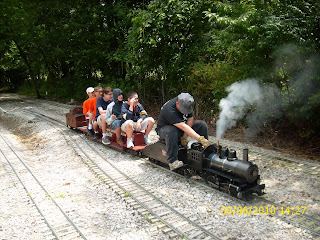
A Short Explaination on Watching the Pod Casts.
The most recent Pod Cast is the one that is showing in the Pod Cast window just below.
When you click on the Pod Cast to view the video, it will play.
When it is finished playing you will see other Pod Casts that have been uploaded show up and you can scroll through them as you wish and pick from any of them to view. Most are only a few seconds long and a couple are about 2 to 3 minutes.


Live Steam Events; past and future.

In the podcast window below you will find a number of short clips from various activities. Enjoy !

FUTURE EVENTS:
Check out the Lake Shore Live Steamers web site for a current schedule of runs. www.lakeshorelivesteamers.com


Live Steam Powered Podcast

Friday, March 4, 2011

Switcheroo Dec. 2010


During the December public run, I brought the Switcheroo out for a little test run. I wasn't sure if the siderods were going to be flexible enough and yet not bind, but as it turns out, the drive line worked fine, except for; set screws on the chain sprockets came loose, the red link belt kept slipping and the linkage to the throttle was way too sensitive. It was either all or nothing. Other than that, it ran fine. I even took off down through a section of track that was not cleared off at all. I was very surprised how far I actually got. And if you look real close at the loco's wheels, you can actually see snow packed in between the spokes. After the run, I sprayed the entire loco with WD-40 and after setting under the back patio (not enclosed) all winter, there is only a slight trace of flash rust on the wheels and that rubs right off with a rag. Gotta love that fish oil.

Tuesday, December 14, 2010

The making of a real steam locomotive.

Hello,
Take a minute and check out the 1928 black and white silent movie on the manufacturing of a full size steam locomotive.
http://www.cinemamuetquebec.ca/content/movies/23?lang=en

Sunday, December 12, 2010

Switcheroo

Shortly after our club's Halloween run, I was on Craig's list and found a hydraulic drive unit. This unit was originally on a 16hp Lesco self propelled leaf blower. Someone had removed the engine and impeller unit and left the carcass and drive unit. I couldn't pass it up. I then found a 5.5hp Honda engine which was once use on a gocart in one of those amusement parks. The only issue with the engine was that it had a 20mm output shaft. That was easy enough to fix because Tractor Supply has hubs that you can weld onto any size pulley you may need. The nice thing about that is you can chuck the entire hub up in the lathe and not have to worry about the vee belt pulley portion. Since 20mm is just over 3/4" ( .787) I just picked up a 3/4" hub and bored it out to 20mm. And the key way in the hub was a little deeper than necessary so by the time all was done, the key fit right in. Next I picked up a 3/4" thick plate for the chassis and sill plates. A piece of 1/2" for the sides and I was ready to start squaring up stock and drilling holes. Before long I was bolting parts together. I wanted to keep things as compact as possible so the short wheel base (18") would not look out of place. When the weather cooperated with a little sun, I decided to fab up a manifold and muffler that resided below deck and since is was going on a Honda engine I called it a Hondafone. My good friend, Richard, suggested an bolt up style manifold with a male and female taper fit in the pipe so a gasket could be avoided. That was also much easier than I imagined. I disconnected the governor from the throttle and made up a quick and dirty, temporary linkage from an old bicycle brake handle. I used all the original hoses and just sort of "stuck" things where I could just so I could get an idea about the belt and sprocket ratios. Apparently this unit is about 10 years old or so and Danfoss, the maker of the pump and orbital mini motor, no longer make pumps. I could find all kinds of info on the OMM (orbital mini motor) but nothing on the pump. Finally, after much prodding from Richard, I got on the phone and after a few hours, I ended up talking to a guy in PA, who knows a few things about hydraulic pumps. I found out that this pump is only a 1.5 gpm and in order to make this OMM move like I need it to, a 5 gpm is what's needed. However, he told that I could spin this pump up to 4000 rpm which would give me about 3 gpm. After another hour of crunching numbers on ratios, I only needed two sprockets and one pulley.
After a couple late night marathons, I was ready to load up and head out to the track for a test run. Saturday the 11th was our "Christmas" run for the public and it was a beautiful day. Sun shinning and about 40 degrees. Other than the throttle being a little too sensitive and set screws backing out or just plain slipping, the engine really was a lot of fun and performed very well. The suspension was right on and never even thought about jumping off, even after plowing through snow and sticks on the rails.

Lesco unit, or what's left of it. There was a crack in the frame just behind the front wheel mount plate. Drive line: Pump, pulleys, OMM, filter, valve, reservoir and hoses.

Home made muffler: AKA Hondafone.
Below deck: Exhaust manifold coming down from above. Lining up Hondafone for fit.
Manifold flange config.

Right side: The engine is up front. Pump is directly over the OMM with less than an inch between them. Oil filter is just setting there for now. And a better look at the manifold.

The underside: Jack shaft assembly. Completely adjustable up and down and front to back. Oil lite bushing instead of bearings.

Top view: pump is right on top of the OMM. Tightening bolts is a challenge.

Sadly, I did not take any pictures during the run, but I am hoping our club photographer did. So I will have to check with him for a couple to post on here.

Sunday, October 3, 2010

Cast iron trucks gets new shoes.

I decided to install a brake system on these trucks because there has been times when I really wished I had a little more stopping power. I went through some magazine articles, specifically the articles on the Fitchburg Northern. As some of you may be aware of, that was the first loco I built. I sold it on e-bay and shipped it out to New Mexico. Anyway, I still have most of the articles from that project and I really liked the tender's brake set up. So, for the most part, here it is.
This first pic is of the bronze ring I turned and then segmented out for the shoes. Yes, I did match the tread taper on the bore of the ring. I use J-B Weld to glue the friction material to the bronze shoe. The non-metalic friction material came from McMaster-Carr.
Here are all the brake components. It took some time to figure out the first set, but once all the dimensions were established, the second truck went fast.

Orginally, the friction material was 1" wide. I used a utility knife to score and split the material into two 1/2" widths. The material was 3/16" thick and a little stiff to bend around the contour of the wheel, but two sided tape and masking tape helped hold things in place while the epoxy cured.
The effort to apply the brakes is so minimal that you can't roll the truck by gently pulling it by the brake lever.
There are extra holes at the bottom of the hangers for springs to help keep shoes from dragging on the wheels. I know, I know, I gotta get that paint off the tires contact patch.
Friday, September 17, 2010

Today all the tires got faced to approx. thickness leaving .025 per side, which will come off after being fit to the rims.
Then all the rims got turned to finish size which is .oo5 over the ID of the tire.

Then the bolsters got finished and are ready to slide into the side frames....after a little filing....

Thursday, September 16, 2010

Truck castings

Picked up a set of cast truck frames at a swap meet. I have always hesitated in purchasing a set just due to the fact that the bearing boxes are one with the frames. This puts a serious damper on the flexibility factor. There is enough meat to put in ball bearings, but that means that either the O.D. or the I.D. has to be a press fit, which removes one more factor in the flexibility department. So I set out to figure a way to use oil lite bushings and keep them from spinning in the bearing boxes.
I wanted to avoid using a pin or a bolt and after my usual "I'll just sleep on it routine." I came up with trimming the flange portion of the bushing and milling a pocket in the frame. I just drilled a 3/4" hole, milled the pocket and dropped the bushing in place. There is plenty of flexibility and the bushing won't spin.
I will drill a small oil hole in the fake bearing box cover, pack felt in the bottom of the drilled hole and drop in the bushing. This will keep the bushing well lubricated and allow for easy bushing replacement when the time comes. I am also intent on putting manual brakes on these trucks.

Besides the truck frames I picked up this year, last year I picked up a good number of cast wheels. Now I just think spoked wheels look fantastic, but on my orginal engineer's car, the wheels were steel and in just four years, I have wore a slight groove in the tread. So, I know that a set of cast iron wheels on an engineer's car won't last very long. What to do ? What to do ?

Do what the real manufactures did, put a steel tire on the cast wheel. I pulled out my 1940 machinist hand book which has all kinds of railroad standards and looked up shrink fits for steel tires on cast iron wheels and sure enough it was in there. The cast iron wheel needs to be .005 larger than the bore of the tire. I'm going to use a propane turkey broiler burner to heat the tire up and then drop the cast iron wheel into place.


So, stand by for updates of this adventure.....

Monday, August 9, 2010

Steam Camp @ NOELS track 2010

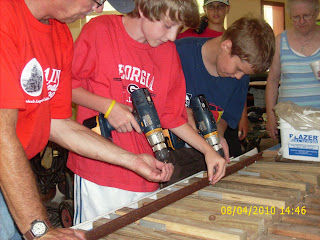
This was the lucky group attending an informal class. There was alot of hands on projects.
And the best (bias opinion) part of all was the steamers.

There was three of us. John Murray with his 0-4-0 switcher; George Santin with his Heisler: and I with my Clishay.
George was the first one out of the steaming bay, he got swarmed.
And here's Mr. Motion, a.k.a. Richard Sales with his easy to run, Shifter.
The campers really enjoyed running the Shifter.
And of course, A Grand Time Was Had By All.

Sunday, August 8, 2010

Discover Live Steam Convention @ Mill Creek Central RR.

In the above photo: I don't know how many times I have seen this gentleman in magazine pictures or on someones website running this Clishay. I never thought I would see him in person. But there he was at the Discover Live Steam Convention at Mill Creek Central Rail Road.


Here is an O.S. Locomotive. The craftsmanship is very good. Ran on propane and first time out on the track, I did not hear any complaints or issues come up. Personally, I did not care for the roar of the burner, only because you couldn't hear the "bark" of the engine working.


Then there was this derailment which occured right in front of Vendor's Row. I heard it as it was happening and I went over to lend a hand. I could not help but take these two pics before helping out. My caption for the last picture would read something like;

"Derailment...What derailment..?"


Back at the campsite, we were right beside a mainline, so in the evening we would sit and watch the locos go by. I downloaded this app for my phone which does some interesting things with pictures. Here are a few examples.
And as a side note, I don't think wearing clothes that match your engine is always a good thing.

Tuesday, May 18, 2010

A rolling chassis

As I had mentioned in my last podcast, I was having some modem issues. The cable guy came out and got things going this morning so I'm playing "catch up" on my blog stuff.
As of 5-10-10 the Heisler has been up on the trucks with drive shafts, gearboxes and cylinders / crankcase in place and linked up.
Everybody is also up on the new engine stand, but I don't have pictures of that yet, but I will soon.
I am trying to use my spare time to get ready for the club meet next month so I can at least have the Heisler out at the track in good rolling order. I should have it at one of the steaming bays, provided they are not all full.